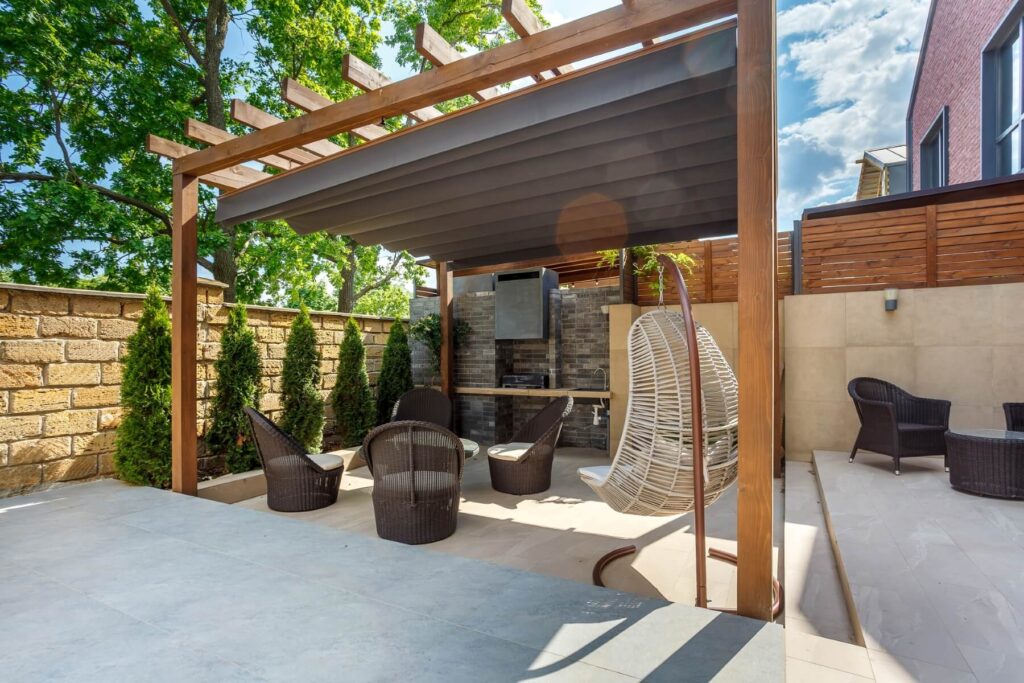

Frequently an integral part of the landscape, retaining walls serve many purposes. Obviously, they are necessary to retain soil when there is a change in grade, but they also define a space – its use, its flow, its character. As designers, the materials we use in a retaining wall design are as important as the plants we choose to place around them.
The type of retaining wall often depends on where you live
Dry-laid stone walls have been around nearly forever. If you’ve ever traveled through a quaint village in England or continental Europe, chances are you’ve seen a charming stacked stone wall or two. Using local materials, these retaining walls have a rustic character and have most likely been rebuilt many times. The cobble wall is ubiquitous in the northeastern United States (and was even the subject of Robert Frost’s Mending Wall), where walls were needed to keep farm animals from roaming too far and farmers had plenty of stones to remove from their fields.
The materials chosen for walls frequently reflect what is available in a particular region. The Northeast has their fieldstone and bluestone, the Southwest has adobe and terra cotta, the Midwest has primarily limestone. When our retaining wall designs call for natural stone, we use limestone, flagstone, and outcropping stone quarried from Wisconsin or Indiana, and bluestone shipped from New York or Pennsylvania.
Manufactured stone expands our palette
Though clay bricks have been in use for hundreds of years, manufactured stone is a fairly recent development. Our favorite manufacturer is Unilock – their innovative and reliable products have allowed us to create beautiful, long-lasting walks, patios, and retaining walls. Being able to produce mass quantities of uniform stones means we have both more colors and styles to choose from without incurring hefty costs. Plus, the versatility allows our clients to extend their personal style and architectural preferences to their hardscape through color, shape, and size.
Other Material Options
Clay bricks are a classic choice for hardscaping but should not be dry-laid like the larger stone walls we install. When a hardscape design calls for brick walls – usually to match brick detail on a client’s home – we use an experienced mason to ensure stability and longevity.
Before the advances of manufactured stone, timber walls were commonly used. Though they are an inexpensive solution, timber walls are not long-lasting and can become a safety hazard when they start to decompose.
When do you need a wall?
When a slope is gradual enough to walk along comfortably, a wall probably isn’t necessary. However, when the desired function is a patio over a slope (which needs to be level!), or there’s a landscape bed that consistently washes out every time it rains, or there’s a steep grade change from say, the driveway to the front door, stone walls are a functional solution. Retaining walls can also accentuate design elements by bringing the colors or materials of the home into the landscape.
Design is critical with walls
A curved wall will echo the undulating bedlines in the landscape – or define the bedline, as shown earlier with the brick masonry wall. Squared-off, linear walls extend the architectural lines of the house into the landscape. Clean lines provide a pleasing contrast to the softer forms of plants; walls in the landscape are a perfect accompaniment.
In addition, retaining walls help define a space with their strong visual weight – they efficiently direct visitors to steps leading them into the home or out into the yard. When placed at the right height, walls can provide additional seating along a patio. Ultimately, a well-crafted wall not only solves a problem but increases functionality.
Know when to hire a professional!
It’s best to have people familiar with the materials and experienced in best practices installing your retaining walls. The designers at Bruss Landscaping know what materials work best in our area and will create a hardscape design that matches your style and needs so your home and landscape reach their potential. To find out more about it, visit us here.